Quotation Document in International Trade

📄 Quotation Document in International Trade: Format, Function, and Practical Application
International trade relies heavily on formal communication and documentation. For importers and exporters, each document plays a strategic role in shaping the transaction. Among these, the Quotation Document is a crucial tool that sellers use to present detailed offers to potential buyers.
This article presents an in-depth overview of the Quotation, explains its components, practical uses, sample structure, and best practices for implementation. Whether you're a trade professional, document manager, or developing your own export-import templates, this guide will give you all the essential knowledge.
🔍 What is a Quotation in Trade?
A Quotation, also referred to as a Commercial Quote, is a document issued by a seller (exporter or manufacturer) in response to a Request for Quotation (RFQ) received from a buyer. It outlines the seller's offer regarding price, quantity, delivery terms, shipment method, and legal identifiers.
It is not a binding agreement but serves as the foundation for a commercial deal. If the buyer accepts the quotation, it can lead to a Sales Contract, Proforma Invoice, or Purchase Order.
To learn more about the RFQ process, see:
🔗 RFQ – Request for Quotation Document | TradeInfo Guide
🧭 Purpose of a Quotation Document
The Quotation document allows both parties to align expectations before entering into a binding contract. It serves multiple purposes:
Summarizes Offer Terms: Price, product specs, quantities, validity, etc.
Facilitates Comparisons: Buyers can assess multiple suppliers.
Acts as Negotiation Ground: A starting point for pricing or condition adjustments.
Supports Contractual Record: Useful for internal approvals or legal reference.
🧾 Key Contents of a Quotation Document
A professional quotation format includes the following structured information:
| Section | Description |
|---|---|
| Quote Number & Date | Unique identifier and issue date. |
| Buyer Reference | Buyer’s internal RFQ number. |
| Expiry Date | Last date of validity for the quote. |
| Seller & Buyer Details | Company name, legal address, country, legal identifiers. |
| Shipping Details | Method of dispatch, shipment type (e.g. FCL, LCL). |
| Payment Terms | CAD, LC, advance, etc. |
| Port Info | Loading and discharge ports. |
| Incoterms® 2020 | E.g., FOB, CIF, EXW, DDP. |
| Product Table | Description, unit, quantity, unit type, price, and amount. |
| Additional Notes | Certificates, documentation, lead time, etc. |
| Authorized Signature & Stamp | Signature line and company stamp space. |
🏢 Sample Case: Exporter to Importer Quotation
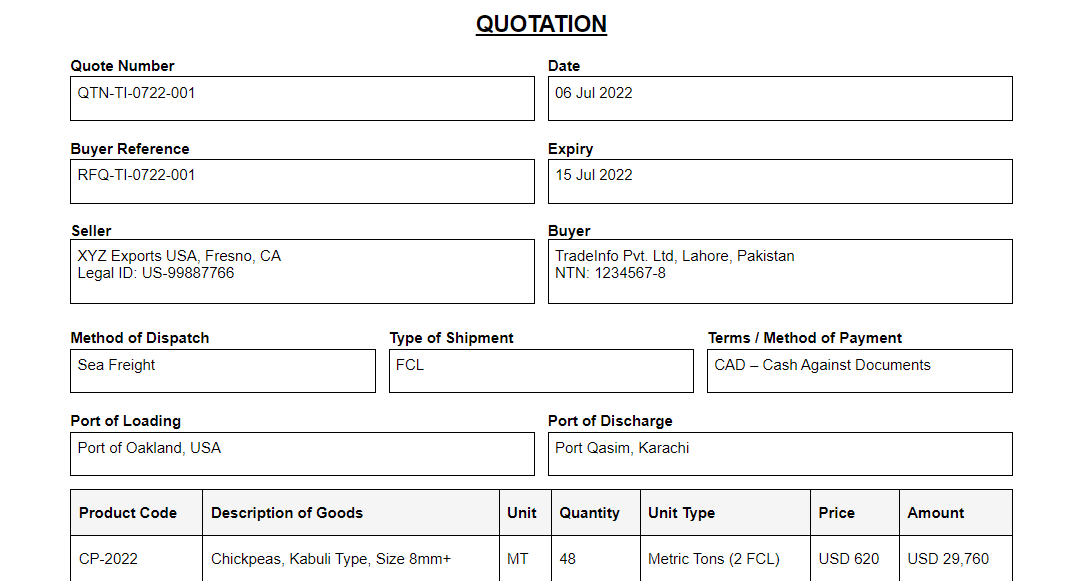
Imagine a case where XYZ Exports USA receives an RFQ from TradeInfo Pvt. Ltd, Pakistan, seeking to import Chickpeas. XYZ Exports issues a quotation with the following information:
Product: Chickpeas, Kabuli type, size 8mm+
Quantity: 48 Metric Tons (2 FCL)
Price: USD 620/MT
Total Amount: USD 29,760
Incoterms® 2020: CIF Karachi
Payment Terms: CAD
Lead Time: 10–14 Days from Purchase Order
This document is stamped and signed, confirming the offer and awaiting buyer acceptance.
📂 HTML-Based Quotation Format (Editable)
Trade professionals benefit greatly from using HTML-based templates for document management. Below is a structured sample format in HTML:
Designed to fit A4
Clean borders
Structured for printing
Editable in any code editor or CMS
This format includes signature space, stamp, and consistent spacing, ideal for export documentation or online downloads.
🖋️ Practical Benefits of the Quotation Document
Here are the main practical benefits of using a quotation in trade:
1. Documentation of Offers
Buyers and sellers can both refer back to the quotation to recall terms, rates, and conditions.
2. Streamlines Business Operations
Trade quotations often become part of internal ERP systems and buyer approval cycles.
3. Supports Trade Audit
Since it's a pre-contractual document, the quotation can be audited for pricing history, dispute resolution, or shipment claims.
4. Customization for Market Needs
You can adapt your quotation based on product category (e.g., agro, textile, machinery), delivery options, or certifications (like Halal, ISO).
⚖️ Legal and International Standards
When preparing a quotation for international trade, compliance with globally recognized practices ensures smoother cross-border transactions:
Use Incoterms® 2020 for defining responsibility between buyer and seller.
State Payment Methods clearly (CAD, LC, TT).
Include Export License or Legal ID (if required in destination country).
Offer additional information like Certificate of Origin, Phytosanitary Certificates, or Inspection Reports.
📊 Product Section Structure
The core of the quotation is the product table. Each line should represent:
Product Code: Internal item reference (e.g., CP-2022)
Description of Goods: Detailed product specification
Unit: Measurement unit (e.g., MT, KG, PCS)
Quantity: Total quantity offered
Unit Type: Common trade format (FCL, LCL, Pallets, etc.)
Price: Unit price with currency
Amount: Extended price (quantity × unit price)
🧩 When Does a Quotation Become Binding?
Although the quotation is not a contract, once accepted by the buyer (in writing or by issuing a Purchase Order), the seller can legally enforce the terms as agreed, especially if both parties acknowledge the offer through email, signature, or platform acceptance.
📤 How to Share a Quotation Professionally
Export the HTML document as PDF
Email the file as an attachment with a professional subject line
Print on company letterhead
Use digital stamp and authorized signature area
Use secure file names and folders
Pro Tip: Maintain version control (v1, v2, final) when sending revised quotes.
📌 Best Practices for Exporters & Sellers
Always use consistent layout and branding
Verify product codes and availability before quoting
Include lead time and shipping duration
Clearly mention validity of price
Avoid rounding off prices unless agreed
Mention exclusions (e.g., duties, VAT, etc.) if necessary
🧠 Quotation vs. Proforma Invoice vs. RFQ
| Document | Created By | Purpose |
|---|---|---|
| RFQ | Buyer | To request pricing from seller |
| Quotation | Seller | Formal price offer with terms |
| Proforma Invoice | Seller | Binding invoice issued upon acceptance of quotation |
👉 Learn more about RFQs here:
🔗 tradeinfo.online/post/rfq-request-for-quotation-document-tradeinfo-guide
📥 Download Empty Quotation Template
You can download the blank Quotation template used in this article, ready for use in your business:
📚 Final Thoughts
In global commerce, clarity is king. The Quotation document is not merely a pricing sheet—it's a structured business offer that carries your brand, professionalism, and negotiation power.
By issuing a well-formatted quotation, exporters can showcase transparency, product readiness, and strong compliance with international expectations. For importers, comparing quotations helps ensure fair pricing, clear delivery terms, and reliable sourcing.
Adopting structured templates like the one shared here streamlines the quotation process, increases operational speed, and reduces misunderstandings. Whether you’re dealing with food commodities, manufactured goods, or services, a solid quotation is the cornerstone of trust and success in trade.
✅ For more document templates and guides, visit https://tradeinfo.online
📩 For support in building your own quotation tools, connect with TradeInfo’s document team.